



Most articles on this topic are generic — squeegee, water-fed pole, list of tools, done. They could have been written by anyone about any cleaner. This isn't that article.
This is what I actually carry to every job, why I chose each piece of equipment, what I tried first that didn't work as well, and what the right tools actually mean for the result on your windows. If you've ever wondered what's behind the price difference between a cheap clean and a proper one, this is the answer.
The Water-Fed Pole System
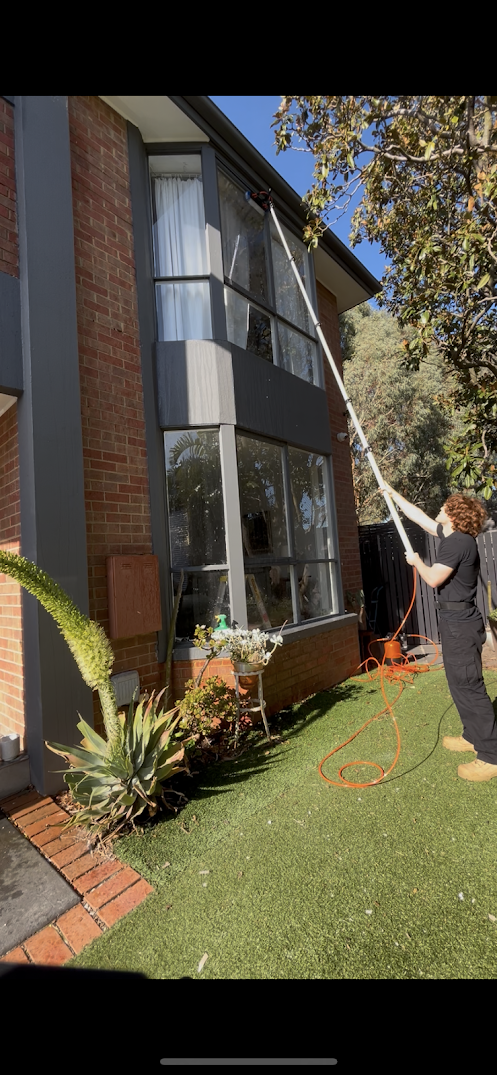
The single most important piece of professional equipment is the water-fed pole — a telescopic carbon fibre pole that delivers purified water to a brush head, used for cleaning second-storey and high-access windows from the safety of the ground.
The pole itself is the obvious part. The less obvious part is what makes it work: purified water with no dissolved minerals. The pole brings water to the glass, the brush mechanically agitates dirt loose, and then the water rinses everything off. Because the water has nothing dissolved in it, when it dries on the glass it leaves no residue — no streaks, no spotting, no need to towel off at height. The window self-rinses to a streak-free finish.
This is why a water-fed pole isn't just a tall squeegee. It's a complete system that produces a different kind of finish.
The water comes from a reverse osmosis filtration unit that I run before each job. Mains water enters the unit, gets pushed through a series of pre-filters and then a reverse osmosis membrane that strips out roughly 99% of dissolved minerals. The output is essentially pure H₂O. This water is what travels through the pole.
A homeowner trying to do second-storey work with a regular hose and a squeegee can't replicate this. Tap water with detergent will leave mineral spots once it dries on hot glass at height — and that's exactly what you can't reach to wipe off.
The whole pole-and-water system is what separates professional second-storey work from amateur ladder work. Faster, safer, and produces a genuinely better finish.
Professional Squeegees
For ground-floor work and interior cleaning, the tool I use most is a professional squeegee — but the term covers a much wider range of equipment than most people realise.
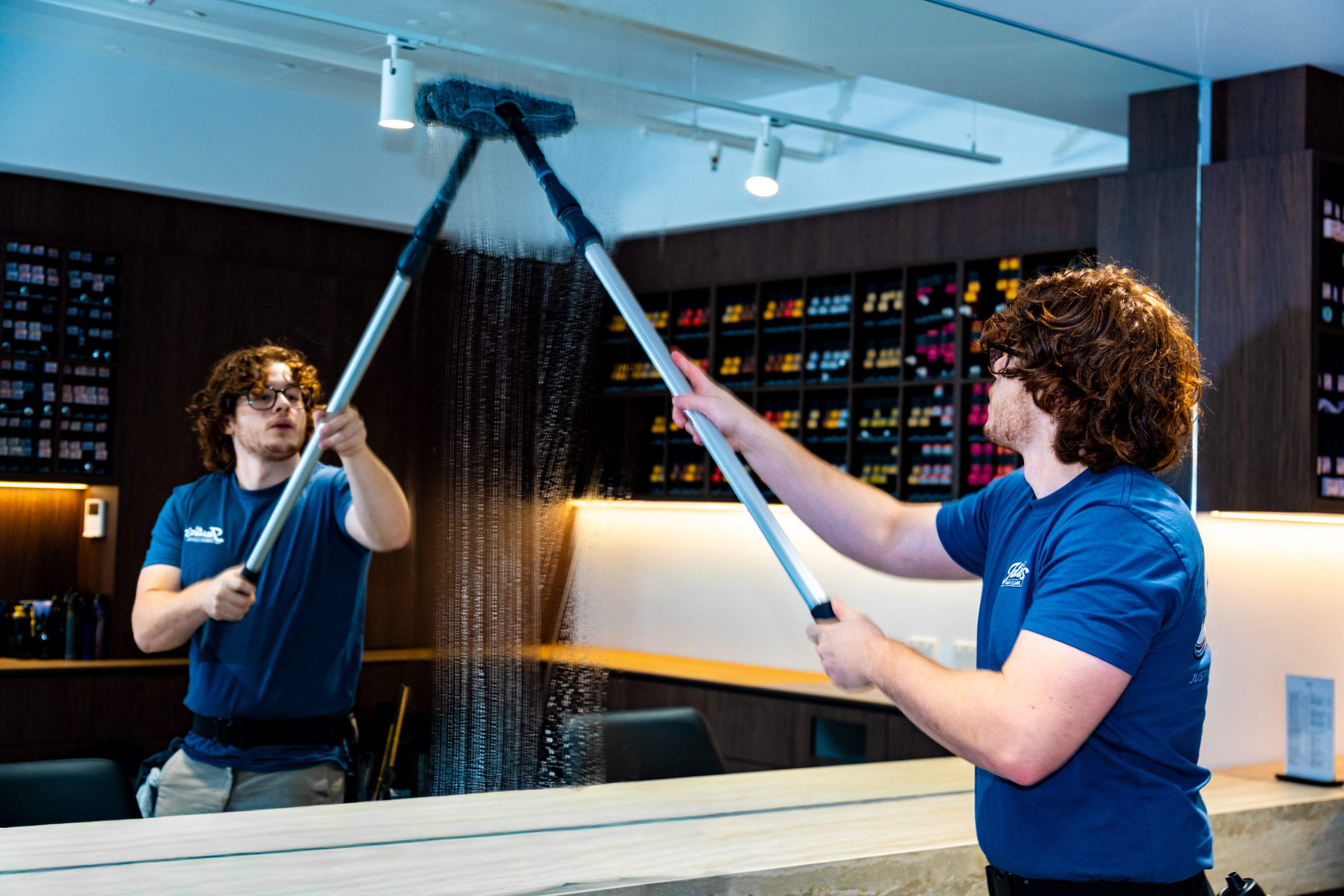
A consumer squeegee from Bunnings is a thin metal frame with a single rubber blade. It works, sort of, on small windows. For professional work, the squeegee is a precision tool: the rubber blade has to be the right hardness for the conditions (softer rubber for warm weather, harder for cold), the blade has to be replaced regularly because even microscopic damage causes streaks, and the channel has to be properly sized for the type of glass.
I carry multiple squeegees in different widths — wider blades for large picture windows, narrower for smaller panes and detail work. The specific brand doesn't matter as much as keeping the blades fresh. A worn blade is the most common reason a squeegee leaves streaks, and most consumer cleaners use blades long past their useful life.
What I tried early on that didn't work as well: cheaper general-purpose squeegees from hardware stores. They're fine for occasional DIY but the blade quality and consistency just isn't good enough for back-to-back professional work. After a few months of trying to make consumer tools work, I replaced everything with proper professional kit and the difference in finish was immediately visible.
Microfibre Detailing Cloth
This is the unsung hero of window cleaning and most homeowners haven't heard of it.
A quality microfibre cloth is used to detail-clean window edges, corners and any spots a squeegee can't reach. It's lint-free (cheap cloths leave fibres), highly absorbent, and the texture is exactly right for picking up small amounts of moisture without smearing.
When you watch a professional clean a window, the squeegee does most of the work — but the microfibre cloth does the finish. The corners where rubber doesn't quite reach, the edges along the frame, the fine line where the squeegee blade lifted off — all of it gets detailed with the cloth.
This is one of the reasons cheap cleans look streaky. Without proper detailing, edges and corners don't get properly finished. Squeegee marks and water beads at the perimeter are visible from inside the house in side light.
Razor Blades and Steel Wool (For Full Detail Cleans)
For the full detail clean upgrade, the equipment expands.
Glass-safe razor blades are used to mechanically remove bonded contamination — paint specks, builder's residue, sealant smears, baked-on bug residue. The key word is "glass-safe." Standard utility blades can scratch glass. Glass-specific blades have a slightly different geometry and edge that lifts contamination without scoring the surface. They're used on a wet window — never dry — to prevent any chance of micro-scratching.
Fine-grade steel wool (specifically grade #0000) is used for hard water deposits and bonded mineral films. The right grade is finer than what's available at most hardware stores — it has to be fine enough to lift mineral deposits without scratching glass. Used wet, with the right grade, steel wool is genuinely safe on glass and removes mineral build-up that razor blades can't get under.
What I tried that didn't work: thinking I could skip the full detail kit and let the squeegee handle everything. For most cleans on properties without bonded contamination, the squeegee is fine. But on first cleans, post-renovation cleans, and any Bayside property with salt etching, the difference between glass that "looks clean" and glass that "is genuinely clean" is what razor blade and steel wool work delivers. There's no shortcut.
Detergent and Cleaning Solution
This is where corners get cut most often by cheaper operators.
The detergent isn't dish soap. It's a low-foaming, high-surfactant cleaning concentrate designed specifically for glass — it lifts dirt without leaving residue, doesn't streak, and rinses cleanly. Mixed at the right concentration with water, it's what gets sprayed or applied to windows before squeegeeing.
Dish soap works in a pinch but it foams too much (foam interferes with squeegee glide), it leaves slight surfactant residue, and it doesn't have the dirt-lifting properties of professional concentrate.
A homeowner who washes windows with dish soap and a sponge can produce reasonable results. They'll never quite get the streak-free finish of professional concentrate plus proper technique, but it's adequate for occasional DIY.
Tracks and Sills Tools
For the track and sill detail upgrade, the kit expands again.
Tracks need their own brushes — narrow, stiff bristles that fit into the channels and dislodge years of accumulated dirt, dead insects, leaves and grime. A general-purpose brush is too wide. A toothbrush is too soft. Track brushes are specifically shaped for the job.
Combined with a vacuum, a stiff-bristled brush, detergent, and patience, track work transforms an old grimy window assembly into something that genuinely looks new. It's slow work — every channel, on every window, has to be cleared and detailed individually. That's why it's a +25% add-on rather than included in the standard.
Ladders
Despite what some people assume, professionals do use ladders — just for the right things.
Ground-floor access where bushes or fences make squeegee work awkward, under eaves where the angle is wrong from below, accessing roof-level windows on properties where the water-fed pole can't reach — all of these need ladders. The ladders are professional-grade aluminium, properly rated, used on stable ground with care.
What ladders are NOT used for: second-storey exterior cleaning on regular homes. That's water-fed pole work. Cheap operators use ladders against render for second-storey windows because they can't afford the pole system, and that's where the corner-cutting begins — slower, less safe, damages the wall, worse finish.
Bucket on a Belt
The single most boring piece of equipment and the most useful. A professional cleaning belt holds a small bucket of detergent solution at hip height, plus a microfibre cloth, plus a squeegee in a holster. This means I can move from window to window without setting tools down or going back to a central bucket. Saves time on every job.
It's the kind of thing you don't appreciate until you've tried doing professional volume without one.
Reverse Osmosis Filtration Unit
I mentioned this above but it deserves its own section. The reverse osmosis (RO) unit is the system that produces purified water for the water-fed pole. It's a multi-stage filter cartridge that connects to standard mains water and outputs water with roughly 99% of dissolved minerals removed.
The unit is in the van. Before each second-storey job, mains water runs through the unit and fills the tanks that feed the pole. The whole setup represents a few thousand dollars of equipment that doesn't exist in any consumer cleaning kit.
The RO membranes need replacing periodically — usually annually — because mineral build-up gradually reduces their effectiveness. The pre-filters need replacing more often. The maintenance cost is real and is part of what professional window cleaning prices reflect.
What This All Costs to Set Up
Honest numbers, because customers sometimes ask: a complete professional window cleaning setup — water-fed pole system, RO filtration unit, professional mops and squeegees in multiple sizes, microfibre cloths, detail equipment, ladder, belt and miscellaneous — costs roughly $5,000–$8,000 to put together properly. Higher-end carbon fibre poles, larger RO units, and a full van setup can run higher.
Plus consumables: rubber blades, microfibre cloths, RO filter cartridges, detergent, glass-safe razor blades and steel wool. Real ongoing cost.
Plus the van. Plus public liability insurance. Plus business registration, accounting, software and website.
When customers compare a $99 quote against a $375 quote, the underlying economics often explain the gap. The $99 cleaner is likely working without proper insurance, with consumer-grade equipment, or both. The $375 quote reflects the actual cost of doing the job properly.
The Tools Are Half the Job
The other half is technique. Knowing which tool to use on which window, when to switch from squeegee to pole, how to read glass conditions to decide whether the full detail upgrade is needed, how to time the job to avoid direct sun, how to move efficiently between windows without backtracking — none of that comes from owning the equipment. It comes from doing 200+ jobs and learning what works.
A homeowner could buy the same equipment I use and produce a worse result, simply because the technique takes time to develop. This is the genuine reason professional cleaning works — it's the combination of equipment and accumulated experience, not either one alone.
Get Your Quote
Instant quote calculator — fixed price in 60 seconds.
For the complete picture on Melbourne window cleaning costs, see the pricing guide.
For more on what separates proper professional work from cheap operators, see cheap vs quality window cleaning.